
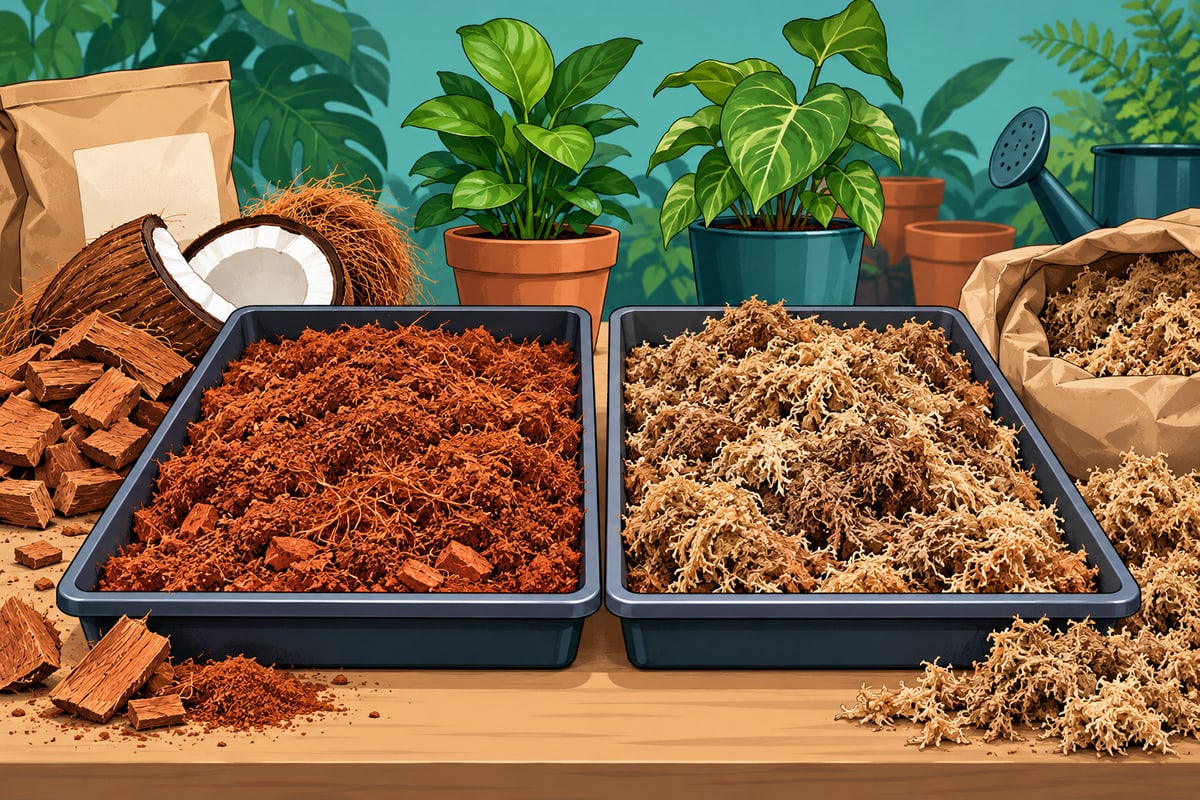
What is the difference between cocopeat and peat moss?
Cocopeat, also called coir pith, comes from coconut husks. Peat moss is derived from partially decomposed plant material collected from peat deposits. They are different raw materials, and neither product name describes a complete growing-medium specification.
University of Florida guidance describes peat as commonly acidic and capable of becoming difficult to rewet after drying. Coir properties also vary with processing and formulation. Ask for the supplied product’s measured pH and treatment history instead of choosing from a generic comparison alone.
| Comparison | Cocopeat sample | Peat-based sample |
|---|---|---|
| Composition | What are the pith, fibre and chip proportions? | What peat grade and other components are included? |
| Preparation | Was it washed, buffered or blended? | Was lime, fertiliser or a wetting agent added? |
| Delivery | Compressed block or ready-to-use loose media? | Compressed bale or loose bag? |
| Testing | Request pH, EC, test method, lot identity and a representative sample for both options. | |
Compare the finished media in your containers
A raw-material comparison is only the beginning. Iowa State Extension notes that particle size, handling and container shape influence media performance. A nursery plug and a tall production pot should therefore be separate trial situations.
For a useful comparison, label each sample and prepare it according to its supplier’s instructions. Use the same container size, crop stage and recording sheet. Write down any changes to irrigation or nutrition rather than treating those changes as invisible parts of the result.
Start with several containers per treatment. Record the filling weight, handling time, wetting behaviour, drainage observations and root condition at agreed intervals. Repeat the trial if a one-off event, such as a blocked emitter, makes a result hard to interpret.
Build a purchasing comparison that includes preparation
List the material price alongside freight, storage space, hydration time and filling labour. Compare a defined usable volume prepared by the same measurement procedure. A lower delivered price per kilogram does not, on its own, establish a lower cost per filled pot.
If you are considering compressed coir, use our 5 kg cocopeat block expansion guide to frame the volume question. For prepared bags, compare the grade and pack specification in the 50 L loose-media range.
Keep commercial and crop observations together. A sample may be easy to handle but require a different workflow; another may fit the existing filling line but have a different delivered cost. Your decision sheet should make these trade-offs visible.
What to send with your enquiry
Include the crop, container dimensions, current substrate, irrigation arrangement and the problem you want to solve. Share your expected order volume and whether you need a compressed or loose format. Ask which sample best matches those conditions.
Agree which written measurements will be used to accept future batches. Keep the approved sample code, test method and quote version together so that a reorder refers to the same specification. For propagation applications, also read the seedling-media guide.
PLAN YOUR NEXT ORDER
Turn your requirements into a clear specification.
Share your application, preferred format and quantity with Teral.
Compare Teral loose media →Sources and further reading
These sources support the technical background. The purchasing checklists and trial-planning suggestions are Teral editorial guidance.