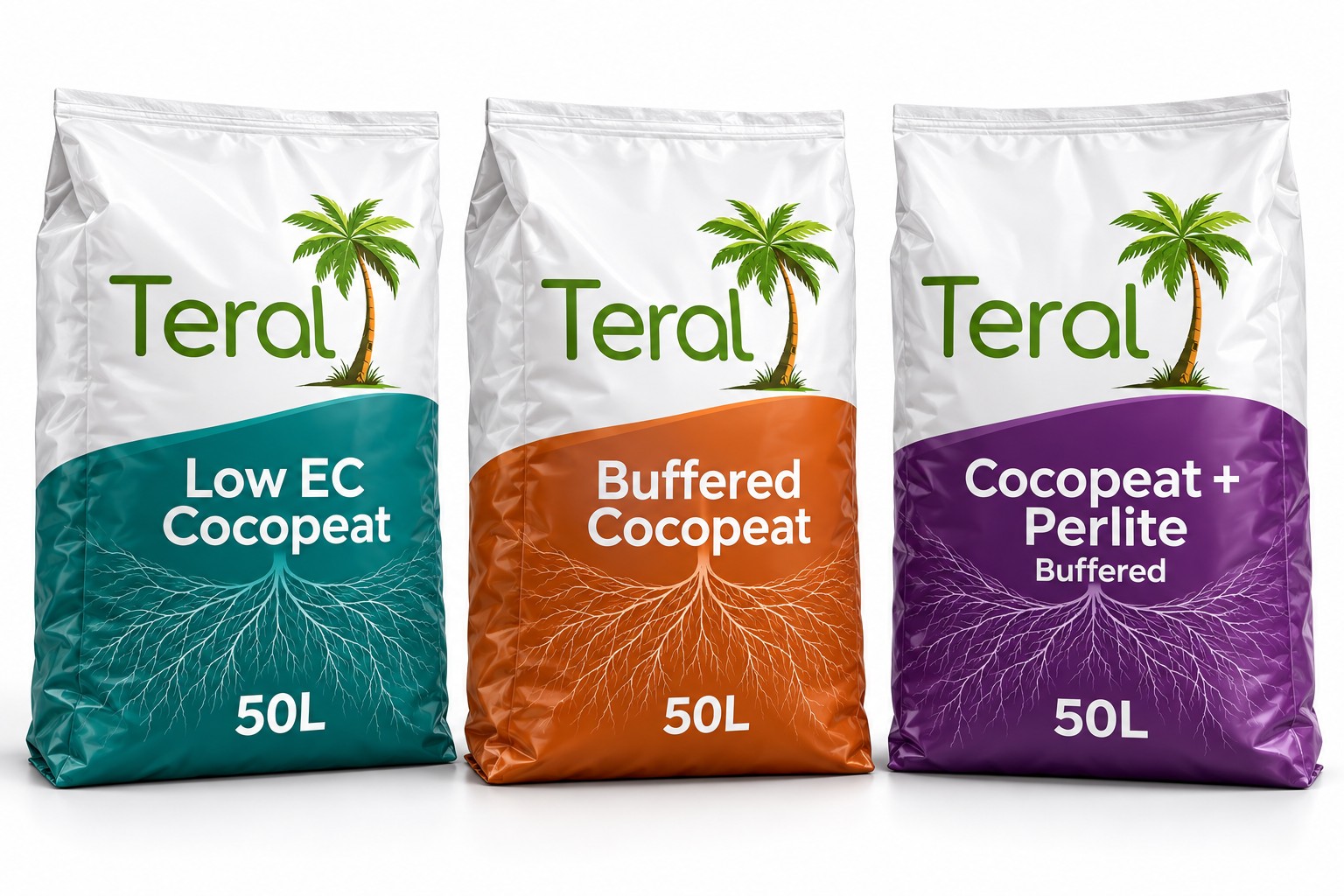
Three options, three starting points
Choose the treatment and texture for the intended use. A 50 L bag identifies a pack volume; it does not establish a complete nutrient programme or guarantee suitability for every plant.
| Teral loose option | What the name tells you | What to confirm |
|---|---|---|
| Low EC cocopeat | Supplied to an agreed soluble-salt specification | EC test method, particle grade and treatment requirements |
| Buffered cocopeat | Coir supplied with buffering specified | EC, buffering specification and intended application |
| Buffered cocopeat + perlite | A buffered coir-based blend containing perlite | Perlite grade, blend specification and container trial |
When a loose format makes practical sense
Loose media can suit a workflow where the team wants material available for filling without first separating a compressed block. It is also useful when comparing grades in a small trial or preparing an agreed nursery mix. The operational benefit is the handling format; the media still needs to be checked for the intended job.
Before ordering, describe the filling equipment and container type. Ask how the supplied moisture condition affects handling and storage. Do not compare a 50 L bag and a 5 kg block by pack count alone: one is sold by declared volume, while the other also needs an expansion specification.
Low EC and buffered are not interchangeable labels
Low EC describes a soluble-salt measurement under a stated test method. Buffering describes a conditioning treatment. A low reading alone does not establish whether coir has been buffered. State both requirements when they matter to your application, rather than assuming one label includes the other.
Use the low EC versus buffered cocopeat article for the detailed distinction. The buying question on this page is how that choice fits your workflow: who will check the material, where will it be used and what other inputs are part of the system?
What the perlite option changes
Perlite is a structural component used in growing-media formulations. Penn State’s propagation-media guidance describes its role in providing air space and drainage. That does not make a perlite mix automatically superior to a coir-only grade. The finished mixture, container and filling method should be evaluated together.
Ask for the agreed particle grade and a sample of the actual mix. Avoid choosing on colour or the amount of visible white material in a photograph. A useful comparison records filling consistency, settling and handling under the same conditions.
Is general loose cocopeat the same as seedling substrate?
No. A nursery filling small cells may need a different particle profile and level of long-fibre screening from a grower filling larger pots. The relevant question is whether the material distributes consistently through the intended tray or container. The pack size alone cannot answer that.
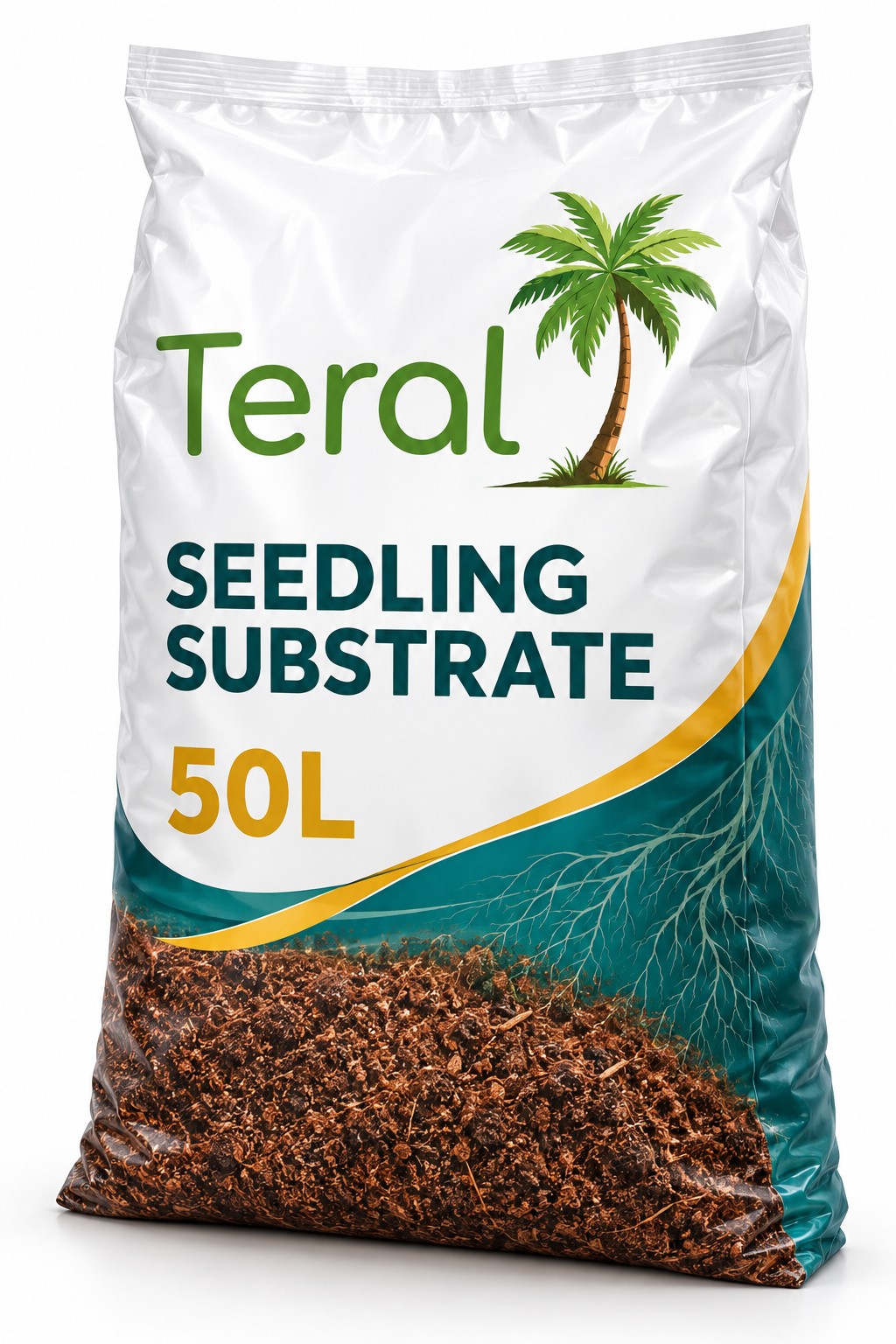
Teral also offers a dedicated 50 L seedling substrate. If your requirement is propagation, send tray dimensions, cell size, filling method and crop details rather than simply requesting a generic cocopeat bag.
A useful first order starts with a sample
Compare the candidate grade with your current material using the same containers and filling procedure. Record pack identification, handling observations and any laboratory results so a repeat order can refer to a clear specification.
Then send the sales team the chosen format, treatment, nominal volume, quantity and destination. Keeping those details together helps ensure the next delivery is ordered against the same brief instead of relying on a short product name.
Technical references
Background reading from universities and horticultural research. Teral product options are subject to the agreed order specification.